
An innovation for painless treatment of disc disease is applied for the first time in Pleven

An innovation for painless treatment of disc disease is applied for the first time in Pleven. The method is available at the high-tech hospital ‘Heart and Brain’ and has helped the first patients, the hospital team said.

Assoc. Prof. Dimitar Haritonov – head of the Neurosurgery Clinic, explained that it is a new generation implant – the so-called discogel. Discogel treatment has been successfully applied in the USA and Europe for several years, and now also in our country – for the time being in the Heart and Brain Center of Clinical Excellence in Pleven. So far it has been applied to more than 10 patients between 20 and 40.

Assoc. Prof. Hritonov noted that the substance is polymerized in the nucleus of the intervertebral disc, improves its functions and strengthens its structure. It is an extremely minimally invasive method, where the patient does not feel any pain and can return to his normal rhythm of life hours after the procedure, he pointed out.

“The indications for the application of the discogel are relatively limited, with the application mainly targeted at patients up to 45 years of age. The method is particularly recommended for the initial stage of disc disease”, clarified Assoc. Prof. Haritonov. He defines the implant as a breakthrough in the treatment of the disease, which is faced by more and more young patients.

“The intervention takes about 30 minutes and is called a surgical procedure, but in practice it is an injection. It is done under general intravenous and local anaesthesia. The injection is placed directly into the nucleus of the intervertebral disc itself, where the appropriate amount of discogel is inserted under X-ray control. Half an hour after the procedure, the patient is able to get up and move about on his own without the need for any help. The only restriction is the fine-tuning of physical exertion within 3 to 4 weeks after the procedure,” the doctor said.
Heart and Brain in Pleven hosted the national forum of medical physicists in radiotherapy

Nearly 60 medical physicists and specialists involved in radiotherapy from almost all radiotherapy centers in the country gathered in Pleven for a two-day national meeting on “Modern Challenges in Medical Physics – Dosimetry and Control”.

Nearly 60 medical physicists and specialists involved in radiotherapy from almost all radiotherapy centers in the country gathered in Pleven for a two-day National Meeting on “Modern Challenges in Medical Physics – Dosimetry and Quality Control in Radiotherapy and Radiosurgery”. The forum was co-organized and hosted by the high-tech hospital Heart and Brain, Pleven, together with the Bulgarian Society of Biomedical Physics and Engineering (BdBFI), IBA Dosimetry and Ferromed 97.

The full article is available here in Bulgarian.

80% of COVID-19 survivors have high blood pressure and rapid heart rate for a long time

80% of COVID-19 survivors have high blood pressure and rapid pulse long after infection, observation by Pleven cardiologists has found. There are also residual symptoms such as easy fatigue, shortness of breath, palpitations and chest pain, according to their analysis of the Bulgarian Cardiology Institute’s “Life after COVID-19” campaign, the largest in the country aimed at patients with so-called long COVID-19. The authors of the studies are medics from the high-tech hospital ‘Heart and Brain’ in Pleven, the hospital told Bulgarian News Agency.

The results were presented to the XVII National Congress of Cardiology 2022 by the team of the Clinic of Cardiology of the hospital in Pleven. Five doctors from the team of prof. Dr. Denis Nikolov, Dr. Borislava Ninova, Dr. Denislava Hristova, Dr. Martina Samardzhieva and Dr. Anyuta Ivanova. Three of the presented topics were focused on patients who had undergone COVID-19.

Dr. Denis Nikolov presented a statistical analysis of patients with COVID-19 and myocardial infarction who have undergone ‘Heart and Brain’ in Pleven and how, based on clinical and laboratory data, the medical team can quickly navigate and make the correct diagnosis and prescribe treatment for the patient.

Dr. Borislava Ninova has collected data on patients who have undergoneCOVID-19, diagnosed with pulmonary thromboembolism, who were assumed to have no other provoking factor. The findings are that COVID-19 appears to be a significant provoking factor for this socially significant disease, which ranks fourth after heart attack, stroke and tumour disease, according to the analysis.

Dr Denislava Hristova has seen patients with so-called long COVID-19. It turned out that 80% of the sufferers had residual symptoms. The complaints were so severe that in half of the cases additional blood tests, X-ray, Holter electrocardiogram and cardiac ultrasonography had to be performed. Rhythm disturbances are the most common changes in electrocardiograms. Various organs and systems are affected, resulting in impaired concentration and memory, headaches, dizziness, insomnia, hair loss, etc. This requires further consultations with various specialists and a change in treatment. Due to presenting symptoms and changes in investigations, one out of ten COVID-19 survivors require readmission to a treatment facility.

Dr. Martina Samardzhieva has presented to the scientific community the only poster with data to determine the likelihood of atrial fibrillation following anti-tumour therapy using modern methods such as stress echocardiography and left atrial strain measurement. This raises the issue of the importance of monitoring cancer patients by a cardiologist before, during and after the administration of antitumor therapy (chemo, immuno, targeted and radiotherapy) and determining the risk of developing cardiotoxicity according to the latest European Society of Cardiology recommendations from 2022.

Dr. Anyuta Ivanova has created a project for early detection of patients with high blood cholesterol levels associated with the genetic disease familial hypercholesterolemia using an artificial intelligence method applied in the hospitals of the Bulgarian Heart Institute. The idea is to identify more and more patients with dyslipidaemia and to start treatment as quickly as possible to reduce the risk of cardiovascular events in this group.

The Cardiology Clinic of ‘Heart and Brain’ in Pleven specialises in the treatment of acute and chronic cardiovascular diseases in an emergency or elective manner. It is a national leader in the diagnosis and treatment of post-COVID syndrome as well as in the field of cardio-oncology. The hospital has both a cardiology and oncology clinic – the only one in the country where cardio-oncology is actually developed.

A multidisciplinary team from ‘Heart and Brain’ Burgas saved the life of a patient with severe oncological disease and combined pathology

Specialists from urology and surgery clinics were involved in the treatment

A multidisciplinary team of doctors from the urology and surgery clinics at the Heart and Brain Hospital Burgas performed a life-saving operation on a patient with a severe oncological disease and combined pathology.

After examining a 66-year-old female patient, operated on for colon cancer 6 years ago, with subsequent radiation and chemotherapy, the team of the Abdominal Surgery Clinic sought further expert opinion of their colleagues from the Urology Clinic regarding bleeding during urination and an established formation in the bladder with impaired renal function. The patient was hospitalized for diagnosis and treatment.

Heart and Brain in Pleven received high recognition for its Radiotherapy and Radiosurgery Centre

The complex oncology and radiosurgery centre of the high-tech hospital ‘Heart and Brain’ in Pleven is among the first selected on a global level for pilot work with a new generation of dosimetric systems in radiotherapy and radiosurgery. The two prototypes provided are extremely valuable because they provide an even better opportunity for precise radiation dosing in each patient thanks to the higher resolution.

“Precise dosing in radiotherapy and radiosurgery is extremely important for the patient and for the results of the treatment. The key to success is good teamwork between the radiotherapists, medical physicists and X-ray lab technicians. However, it is also crucial to have precise modern equipment, which I am glad we have and are able to work with. This ensures the highest level of treatment quality and additional peace of mind for our patients,” commented Ivo Petrov, Head of the Medical Physics Unit at the hospital, part of the interdisciplinary team involved in radiotherapy and radiosurgery.

The radiotherapy and radiosurgery centre in ‘Heart and Brain’ Pleven has no analogue in the country and in the Balkans. It has the only Gamma Knife in Bulgaria – the most precise system for brain radiosurgery, with the latest generation of high-tech linear accelerator for radiotherapy and radiosurgery in the whole body, 4D CT scanner, top level dosimetry equipment and specialized planning systems.

The full article is available here in Bulgarian.

Prof. Dimitrov: Medical care in the first 4 hours and 30 minutes from the onset of an ischemic stroke is crucial for the patient’s recovery

On the occasion of World Stroke Day – 29 October, the specialist gave detailed information and advice on proper treatment

Prof. Ivan Dimitrov is qualified in neuropsychology, electroencephalography, evoked potentials, Doppler sonography. His professional and scientific interests are in the field of cognitive disorders and dementias, multiple sclerosis, epilepsy, etc. He organized the first study on the prevalence of dementias in Bulgaria.

– Professor Dimitrov, what is stroke and how is this disease diagnosed?

– Cerebrovascular diseases are widespread in our country and are unfortunately among the causes of severe disability and significantly increased mortality. More prevalent are ischemic strokes, which are associated with blockage of blood vessels supplying the brain, and the result is death of brain tissue. This leads to paralysis, speech impairment and other neurological symptoms and, unfortunately, often to death.

– What are the first symptoms of the disease and can they mislead the patient and treating physicians in making the diagnosis?

– Common first symptoms include weakness of the limbs (often left arm and left leg or right arm and right leg), drooping of the lip, speech disorders, balance disorders, etc. It is important that these are recognised by people so that action can be taken quickly. Similar symptoms can occur in other neurological disorders, but timely examination by a specialist and appropriate investigations will determine the correct diagnosis.

– How can patients and their loved ones help doctors to better manage the disease?

– Prevention of risk factors is important. They are known to everyone – high blood pressure, poorly controlled diabetes mellitus, elevated cholesterol, smoking, etc. Very often, however, not enough attention is paid to them. It is also of paramount importance for physicians seeing a stroke patient in an emergency setting to quickly obtain adequate information about the exact time of onset of complaints, comorbidities, medications taken, including whether any are being taken to “thin” the blood.

– What opportunity does early diagnosis provide to counteract the disease? How is the treatment of patients with ischaemic stroke?

– In recent years, the motto “time is brain” has become popular in neurological circles. This is indeed a true statement because there is a greater chance of successful treatment of ischemic stroke in the first few hours after the onset of symptoms. If the patient is promptly transported to a specialized hospital facility within a time window of up to 4 hours and 30 minutes from the onset of the stroke, thrombolytic treatment can be administered to try to restore circulation to the affected area. Unfortunately, if this time is exceeded, thrombolysis cannot be performed, and the treatment is not as effective.

– What tests do you do at Heart and Brain to confirm such a diagnosis? Do you perform the thrombolysis already mentioned?

– At Heart and Brain, all the necessary tests are carried out. In addition to a general and specialized neurological examination, laboratory tests, computed tomography, if necessary – with imaging of cerebral vessels, radiographs are carried out in an urgent order. Doppler sonography, magnetic resonance imaging, etc. are also applied. Teamwork of neurologists with fellow cardiologists, vascular surgeons and doctors from other specialties is important. On admission of a patient with ischaemic stroke, we always assess and if appropriate – perform thrombolytic treatment.

Heart and Brain Center of Excellence’s team saved the leg of a man with angle grinder injuries

Patient: This hospital is world class, the attitude of the doctors, nurses and orderlies to all of us patients is irreplaceable. Thank you very much!

A few days ago, a man was admitted to the emergency room of Heart and Brain in Burgas with deep injuries from angle grinder and heavy blood loss. The young man injured himself during repairs in the Tsarevo area. The damage to his limbs was not life-threatening, but he risked being bedridden for a very long time to recover. The team of specialists at the Heart and Brain Center of Medical Excellence processes performed various surgical interventions so that the patient recovered in the shortest possible time without permanent work disabilities.

Read the full article here in Bulgarian.

Veliko Tarnovo Cardiology hospital : “CHILDREN SAVE LIVES”

The initiative was launched in connection with the World Heart Restart Day, which is now traditionally celebrated worldwide on 16.10.2022. The main objective is to raise awareness among the public and our children about cardiac arrest and promote cardiac massage and artificial ventilation (CPR) skills. Seven out of ten cardiac arrests happen in public places in full view of the public, but less than 20% of witnesses provide first aid. Hundreds of thousands of lives could be saved each year if two hands help in the first minutes of an incident.

The meeting was with sixth grade children from Bacho Kiro Primary School in the city with the outstanding assistance of the school principal Mr. Nikolov. The young cardiologists Dr. Ivanov and Dr. Nedyalkova, with the ideas and support of Dr. Krastev, an invasive cardiologist, had prepared a multimedia presentation and a visual demonstration. Dozens of children practiced what they saw, enthusiasm shining in their eyes. The specially prepared dialogue unlocked many questions and enriched the children’s knowledge. All participants received badges, which mark initial training in first aid, and special children were awarded with T-shirts with the logo of the Cardiology hospital.

Master class for thoracic surgeons was held at Heart and Brain Center of Excellence in Burgas

The course was accredited by the Bulgarian Medical Association and all participants received the maximum 13 points.

One of the most famous and recognized modern breast surgeons in the world – prof. Tomáš Štupnik, held a master class for his colleagues at the high-tech Heart and Brain Hospital Burgas. The distinguished specialist performs the most complex operations in thoracic surgery, including lung transplants, lung segmentectomies, carina and trachea surgery. He is one of the pioneers of single portal VATS surgery (video-assisted thoracic surgery).

In May this year, Dr. Dimo Mitev and Dr. Ivoslav Ivanov – part of the team of the Department of Thoracic Surgery – participated in the first stage of specialization in uniportal VATS anatomical lung resections under Prof. They were also participants in the first stage of the study in Ljubljana, Slovenia. The head of the department, Assoc. Prof. Rumen Filipov, invited the leading professor to carry out the second part of the international training in the high-tech hospital in Burgas.

The first robot-assisted gynaecological surgeries with da Vinci X were launched in Heart and Brain Pleven

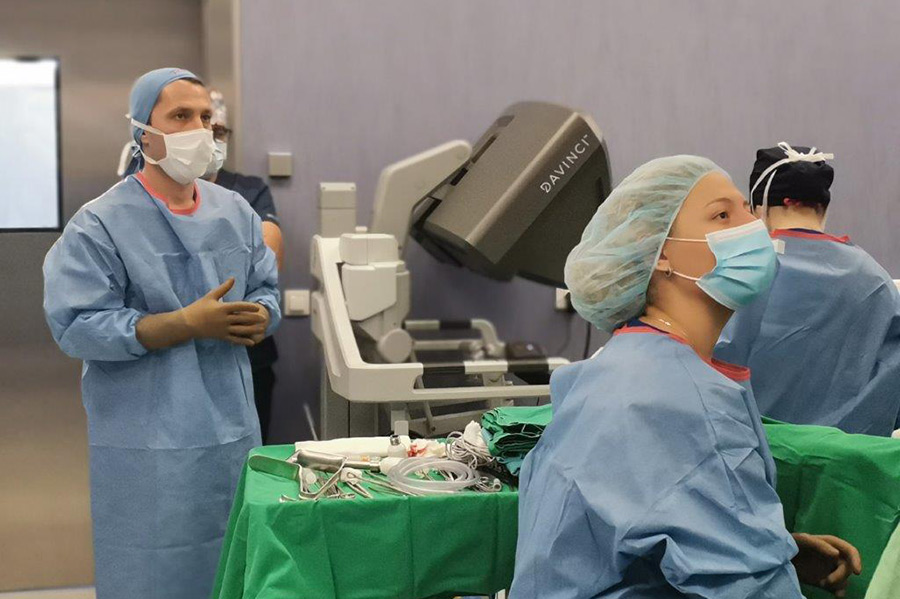
Gynaecologists from the high-tech ‘Heart and Brain’ in Pleven have launched the first robot-assisted surgeries with the da Vinci X system with four hands. The intervention was performed under the guidance of Dr. Aleksander Lyubenov – console surgeon and head of the department of general and oncological gynecology, surgeons next to the patient – Dr. Tsvetomir Ivanov and Dr. Gergana Popova, senior operating midwife Ralitsa Hristova and her team.