Master class for thoracic surgeons was held at Heart and Brain Center of Excellence in Burgas

The course was accredited by the Bulgarian Medical Association and all participants received the maximum 13 points.

One of the most famous and recognized modern breast surgeons in the world – prof. Tomáš Štupnik, held a master class for his colleagues at the high-tech Heart and Brain Hospital Burgas. The distinguished specialist performs the most complex operations in thoracic surgery, including lung transplants, lung segmentectomies, carina and trachea surgery. He is one of the pioneers of single portal VATS surgery (video-assisted thoracic surgery).

In May this year, Dr. Dimo Mitev and Dr. Ivoslav Ivanov – part of the team of the Department of Thoracic Surgery – participated in the first stage of specialization in uniportal VATS anatomical lung resections under Prof. They were also participants in the first stage of the study in Ljubljana, Slovenia. The head of the department, Assoc. Prof. Rumen Filipov, invited the leading professor to carry out the second part of the international training in the high-tech hospital in Burgas.

The first robot-assisted gynaecological surgeries with da Vinci X were launched in Heart and Brain Pleven

Gynaecologists from the high-tech ‘Heart and Brain’ in Pleven have launched the first robot-assisted surgeries with the da Vinci X system with four hands. The intervention was performed under the guidance of Dr. Aleksander Lyubenov – console surgeon and head of the department of general and oncological gynecology, surgeons next to the patient – Dr. Tsvetomir Ivanov and Dr. Gergana Popova, senior operating midwife Ralitsa Hristova and her team.

BСI hospitals celebrate world heart day with different manifestations

The cardiologists of BCI will go to small settlements for the elderly, they will consult the citizens of Burgas, Varna, Shumen, Yambol, Veliko Tarnovo for free after prior registration, they will teach patients what physical exercises will improve their quality of life and heart health, they will open their doors to all patients who are looking for a consultation with established specialists, will participate in the national congress of cardiologists with lectures dedicated to chronic heart failure and poster sessions.

True to the slogan: We heal more hearts than Casanova broke in a lifetime, we will welcome you with care and attention and guide you on how to improve your heart health!


Dr Elitza Betcheva: Sometimes the geneticist “stays” with the patient and his family for life

– Dr Betcheva, what does the geneticist do?

The doctor specializing in Medical Genetics completes the standard 6-year training in medicine. Then he specialized for 4 or 5 years (it depends on the country), the so-called human or clinical genetics, and then take a state exam in the specialty. A medical geneticist uses his knowledge to recognize and diagnose genetic diseases and predispositions and, if possible, to offer genetic or other, often personalized, treatment. Another important task of the genetic doctor is to explain to the patient all the necessary information in an understandable format and to read constantly to keep up with the latest data, and there is a lot of it.

– What are the challenges? What kind of patients do you work with?

– Working as a geneticist in clinical practice is very challenging in terms of the range of medical knowledge that one must possess. Excluding some, few, specific areas of medicine such as trauma medicine, there is almost no specialty for which a geneticist does not need to be prepared. In a larger, central clinic with genetic counseling, a geneticist may need to apply knowledge of oncology, embryonic development, pediatrics, neurology, and cardiology in a single day. Patients may be infants, children, the elderly, may be pregnant women, people with genetic or cancer disease, or troubled healthy relatives.

The geneticist should be able to tell at the time of meeting the patient by external features that might normally escape the eye – what is the shape of the nose, how are the eyes positioned, are the body and head dimensions peculiar, what is the posture and gait, are there any skin features. In a large number of cases it is necessary for the geneticist to conduct a thorough examination of the body, which for many patients is a cause of embarrassment. In Western clinics, detailed photo documentation is also done on children or adults with manifestations of genetic syndrome, which in our country is highly unacceptable for many parents and patients. The photographs are necessary for the geneticist to be able to concentrate well after the consultation on any features that he or she has not had the opportunity to address. We often have to consult other colleagues, even from abroad, as these are extremely rare diseases.

At the same time, the geneticist has to be empathetic, to some extent a psychologist, to feel the patient’s fears and emotions and to tailor his approach to them. He or she must know when and how to present information and, especially, certain genetic test results whose implications may be difficult to accept. At the same time, the geneticist has no right to influence in any way the patient’s decision whether to be tested, treated in a certain way or operated on. He must present neutrally and in a fully understandable form all the information necessary for the patient to make an informed decision. The geneticist must have the patience to clarify things repeatedly because the matter is difficult to understand, even for other physicians. Sometimes the patient needs to talk to the geneticist after the consultation when more questions or concerns arise. Sometimes, the geneticist “stays” with the patient and his family side for life.

The full article is available here in Bulgarian.
https://www.24chasa.bg/zdrave/article/12408884

The first robot-assisted urological surgeries in Heart and Brain in Burgas have started

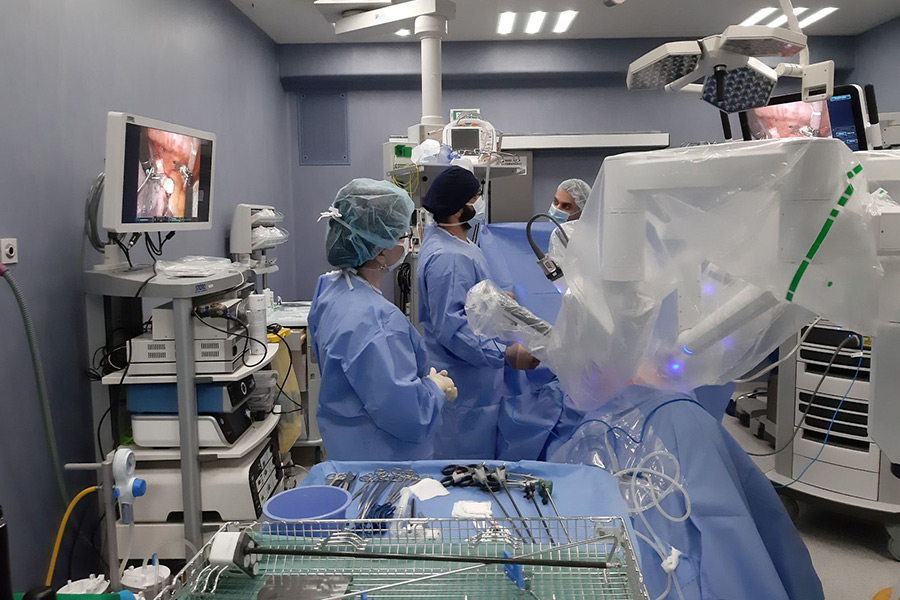
Urologists from the high-tech Heart and Brain Hospital have performed the first robot-assisted surgeries in the Burgas region with the da Vinci X four-handed system. The proctor was prof. Marin Georgiev, who has performed over 1200 robotic surgeries, console surgeon – Dr. Toni Statelov – Head of the Urology Department, and assistant – Dr. Angel Kirov.

The team performed radical prostatectomy on two patients diagnosed with carcinomas and one nephrectomy on a patient with a tumor in the kidney. Currently, all three are feeling great and recovering. The precision offered by robot-assisted surgery, the minimal invasiveness and the extensive experience of our specialists ensure a shorter hospital stay, faster recovery and minimal blood loss.

In less than two months, the device has become an indispensable assistant to the thoracic and abdominal surgery and urology teams.

Doctors from Istanbul refer patients to “Heart and Brain” Pleven

The unique equipment is part of the Complex Oncological and Radiosurgery Center in the high-tech Heart and Brain, Pleven, which is unparalleled in the country and the Balkans.

In 2012 Eugenia was only 17 years old when she was diagnosed with multiple benign intracerebral tumours, mainly on the periphery of the brain and the meninges. The largest was located in the left hemisphere, near the brainstem (the part of the brain where the centre of respiration and heart activity are located). A similar benign tumor, but smaller in size, is located mirrored and on the right side of the head. The patient has other tumors, but of sizes and locations that do not threaten her health at this time. Due to the proximity of the tumors, neurosurgical intervention was not possible and the patient was referred for radiosurgery in Istanbul (at that time there was no radiosurgery equipment in Bulgaria).

The radiosurgical procedure done abroad is ionizing radiation and covers both areas of the brain that are irradiated with a dose of 25 Gy (Gray), with 3 irradiations in the left and 2 irradiations in the right hemisphere, respectively. The complexity with Eugenia is that the two irradiated areas are in close proximity – on either side of the most important brain structure.  The intervention cumulatively exposed the patient to a dose of radiation close to the critical dose, but the development of the tumor process was halted for 8 years.  In 2020 – 2021, a new growth was observed that squeezed and deformed the brain stem. Due to the proximity of the tumours to the respiratory and cardiac centres, the fear of complications is serious and repeat radiosurgery in Turkey is delayed. This results in irreversible damage to the auditory nerves and complete hearing loss. Eugenia and her family sought help from specialists at home and abroad, but everywhere they were denied both surgery and radiosurgery.

In June last year Jenny was consulted again in Istanbul, where she was recommended radiosurgery treatment at Heart and Brain Pleven. There is the most advanced in the Balkans and the only Gamma Knife in Bulgaria. Collegially, the Turkish doctors sent the documents with the initial treatment. A multidisciplinary team of radiosurgeons – Dr. Rumen Lazarov, Dr. Nikola Bildirev, the leading neurosurgeon Assoc. Prof. Dimitar Haritonov and doctors from several other specialties. They decided to carry out treatment by irradiation. The treatment dose was carefully tailored to the radiation already accumulated in Eugenia’s body, as well as to the time that had passed between the first treatment and the current one in Pleven.

The repeated need for a patient to undergo radiotherapy is a real challenge in medicine. The doctors again administered a dose of 25 Gy, divided into 5 fractions, and included decongestive (anti-swelling) therapy – before, during and 2 weeks after the treatment, with a gradual reduction in dose. Precision in defining the boundaries of the treated area in the brain, constant monitoring of the patient’s position (any twitching in the body leads to automatic cessation of radiation) and direct connection to the MRI, ensuring accurate imaging, are additional prerequisites for the success of the treatment. The patient feels well and has no side complaints.  Along with the knowledge of the doctors and the capabilities of the modern equipment, the key is the trust gained in the team and the return of hope in the young woman.

Today, Eugenia is 27 years old and the Heart and Brain doctors continue to monitor her condition and keep in touch with the family. “I am grateful to the Heart and Brain doctors in Pleven because they saved my life,” she says.  She feels well, enjoys the support of her husband and family and is making plans for the future. “By telling the story of my treatment, I want and strongly hope to help other patients like me get the help they need. The doctors and equipment in Pleven helped me and my family after months of wandering around clinics abroad,” says Eugenia.

Cardiac surgeons at ‘Heart and Brain’ Burgas mark three years since the first non-operative aortic valve replacement

The last patient in whom TAVI was performed was 60 years old, on dialysis for 5 years. On the fifth day after the procedure, he was feeling well and preparing for discharge

For three years now, the cardiac surgeons at Heart and Brain Burgas have been applying a gentle non-operative method for aortic valve replacement (TAVI). So far, the team of Dr. Penchev, Dr. Kornovsky, Dr. Gradinarov and their assistants has helped 73 patients using this minimally invasive technique. Initially, the method was introduced in the Burgas high-tech hospital together with the leading invasive cardiologists from the Czech Republic – Dr. Mathez and Dr. Zemanek.

TAVI is used to treat patients with severe aortic valve narrowing. Aortic stenosis is a valvular disease characteristic of the elderly.

The Heart and Brain team performed a unique robot-assisted surgery in Burgas

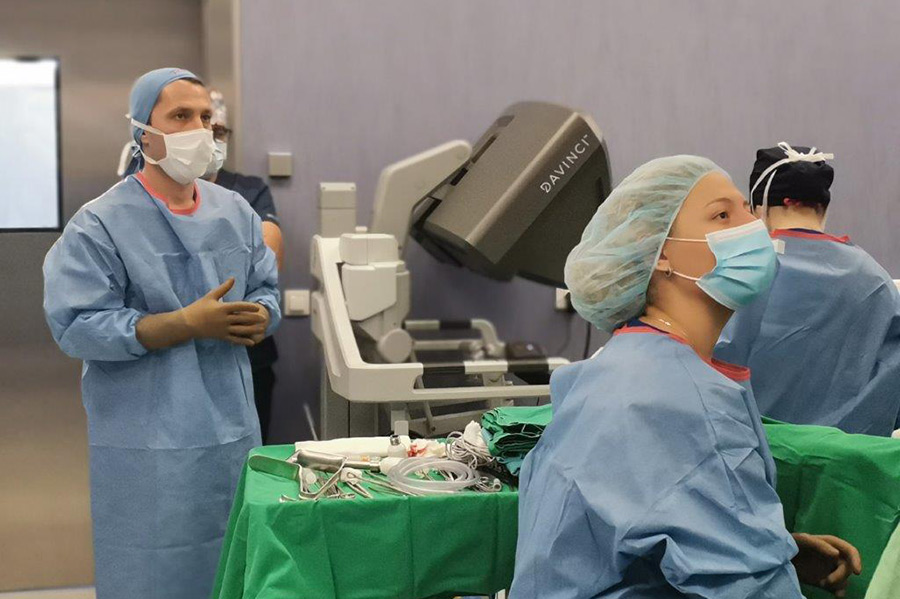
The team of the thoracic surgery clinic of Heart and Brain Hospital, Burgas, led by Assoc. Prof. Dr. Rumen Filipov, performed a unique surgery for Bulgaria. The latest-generation da Vinci robotic system helped the specialists to perform a successful, bloodless and patient-friendly hiatal hernia operation through the chest. In this condition, the abdominal organs enter the chest through an opening in the diaphragm (the so-called hiatus) through which the oesophagus normally passes.

This is the fourth operation in a row with the da Vinci four-arm robotic system – the only one in Southeaster Bulgaria. Just a month after the first intervention, anatomical and non-anatomical lung resection, thymus surgery and hiatal hernia surgery were performed in the Department of Thoracic Surgery.

The team that performed the surgery consisted of: Assoc. Prof. Dr. Rumen Filipov – console surgeon, Dr. Dimo Mitev – surgeon in the sterile field, Dr. Kaloyan Junov – anesthesiologist.